
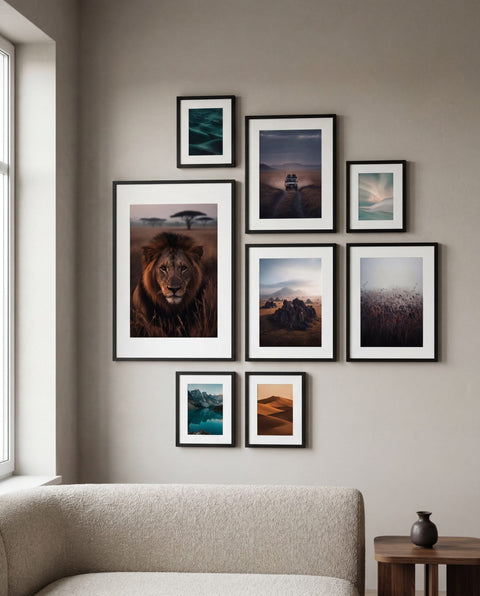
The Salon-Style Gallery Wall: A Guide to the Petersburg Hanging
A Petersburg hanging is a dense gallery wall where works of different sizes grow outward from an imagined center line — held together by small, even gaps instead of a strict grid. The style comes from 18th-century salons and the Hermitage in Saint Petersburg, where paintings hung frame to frame out of sheer necessity. Born from lack of space, it became the most elegant way to turn many pictures into one statement.
What is a Petersburg hanging?
Three things define it: many works in tight company, mixed formats, and an invisible order. Unlike a grid, nothing sits at equal height — every frame aligns to imagined lines instead: one horizontal center axis, plus the edges of its neighbors. The result reads as grown, not arranged; abundant, not cluttered.
It differs from the formal grid hang (identical formats, identical spacing) and the edge hang (all works sharing one top or bottom line). The salon wall is the most personal of the three: it shows a collection, not a decoration.
The three rules of a dense hang
1. The center line holds everything. Place an imagined horizontal axis at 57–60 inches (145–150 cm) — gallery eye level. The wall grows up and down from this line, not from the ceiling or the sofa.

2. Small, equal gaps. Keep 2 to 3 inches (5–8 cm) between frames — everywhere. That constant gap is the secret: it merges many pictures into one surface. Let the gaps drift, and the wall falls apart.

3. Large anchors, small fills. The biggest work never sits at the edge. Place it near the center — slightly off-axis feels more alive than dead-centered. Mid sizes build around it; small formats fill the edges.
Step by step
1. Lay it out on the floor. Tape the wall's dimensions onto the floor and arrange everything there until the composition holds. Photograph the final layout.
2. Cut paper templates. One per frame, full size. Tape them to the wall and shift until axis and gaps are right.
3. Hang the anchor first. The largest piece goes up first — everything else aligns to it.
4. Work from the inside out. Anchor to edges. After every frame: measure the gap, check the level, then the next nail.
5. Leave it unfinished. A salon wall is allowed to grow. Leave room at the edges for what you haven't found yet — that's part of the charm.
Unsure about heights, spacing or fixings? The basics live in our guide: how to hang pictures — height, spacing and methods.
What works on a dense wall — and what doesn't
A dense hang — say, a gallery wall in the living room — forgives a lot, but not everything: what holds the wall together is the color world. Keep every piece in one mood — like moody, color-rich nature in deep teals and warm ambers — and formats and subjects can mix freely. Let the palette jump, and no layout will save it.
A proven mix: one large statement (around 60 x 80 cm / 24 x 31 in), two or three mid formats, and small accents. Matching frames — solid wood in matte black with a passe-partout — give mixed subjects extra calm.
Grid, edge line, or salon?

The grid hang (identical formats, exact columns) reads calm and formal — ideal for series. The edge hang (one shared top or bottom line) is the modern middle — good above sideboards. The Petersburg hanging is the most personal of the three: start with three or four works and let the wall grow, and you get a room that tells its own story.
FAQ
How much space between frames?
2–3 inches (5–8 cm), kept constant. Up to 4 inches on very large walls.
How many pictures do I need?
The effect starts at five; there's no upper limit. The shared color world matters more than the count.
Do all frames have to match?
No — but stick to two or three frame styles. The wilder the subjects, the calmer the frames.
How high should the center sit?
Center the whole arrangement at 57–60 inches (145–150 cm). Above sofas: bottom edge roughly 8–10 inches (20–25 cm) above the backrest.
Can I start small?
Absolutely. Three works around one axis are the beginning of every salon wall — the rest arrives over time.
Ready for the first row? Explore all fine art prints — five sizes, framed and ready to hang, or with a border for your own framing.
Comments (0)
There are no comments for this article. Be the first one to leave a message!