
What Is Generative Art? An Honest Answer About AI Art
Generative AI art is art made with generative models as the instrument — and made art by human decision: concept, composition, curation. The model produces images; whether one becomes a work is a human call. That distinction is this whole article in one sentence.
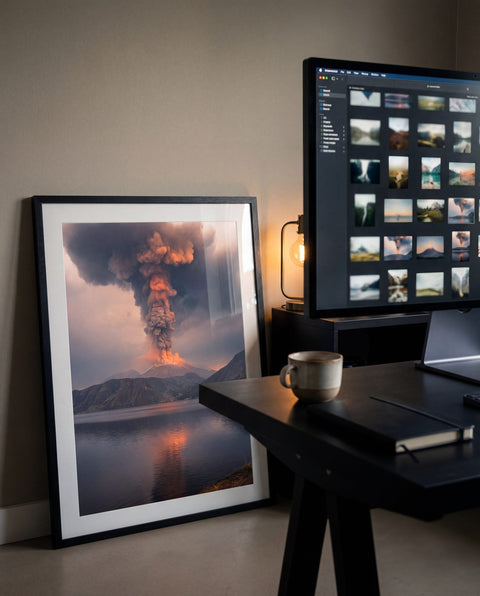
On the screen: 480 candidates for one collection. On the wall: a single framed work. Everything you need to know about generative AI art lives between those two images.
Three terms, three different things
What is generative art?
Generative art is art made from rules, systems and algorithms — the human defines the system, the computer executes it. It is older than any AI: when Georg Nees exhibited the world’s first computer-generated graphics in Stuttgart in 1965, the question we’re still asking today already hung in the room.
What is AI art?
AI art is its youngest form: generative models translating descriptions and references into images. The tool is new — the discipline behind it, selection and composition and intention, is not.
What are AI images?
AI images, finally, are what models output by the million every day — output, not work. The line doesn’t run through the tool; it runs through intention. A work has a signature, a decision, a reason to exist.
From plotter to diffusion model — four milestones:
- 1965 — Georg Nees exhibits the first computer-generated graphics, in Stuttgart.
- 2014 — Generative Adversarial Networks (GANs) make AI image-creative for the first time.
- 2022 — diffusion models bring text-to-image to the mainstream.
- 2026 — the EU AI Act makes machine-readable labelling mandatory.
Is AI art real art?
The question is older than the technology. In his Salon review of 1859, Charles Baudelaire denied photography any claim to art — calling it the refuge of every failed painter. A century and a half later, photographs hang in MoMA. Every new medium passes through the same suspicion: first a tool, then a threat, then an art form.
The honest answer: AI art is art exactly when someone makes it so. The AI is an instrument — and like any instrument, the output reflects the person playing it. Anyone can press a button; that’s not the work, that’s the doorway. The work is taste: knowing why one frame holds and a thousand don’t. The barrier to entry in AI art is low. The barrier to excellence is exactly as high as it’s always been.
At chaipeau this principle is called Artistic Intelligence: the tool is generative, the eye is human — moody, color-rich nature art, openly declared as AI-generated. That honesty is the signature.
Definition — Artistic Intelligence: the practice of directing generative AI models as an artistic instrument. The human owns concept, composition and curation; the model executes. Coined by chaipeau as the counterpoint to arbitrary AI output.
How a work gets made: the process behind chaipeau
No magic button — and, above all, no human typing prompts at a screen. I don’t write prompts. I built a process: a framework that doesn’t imitate the classic National Geographic editorial path but virtualises it — from briefing through research and narrative to the edit at the light table. Version-controlled and changelog-driven like software, in ten steps. My instrument is not the single sentence handed to the machine; it is this process — and the judgment at the end.
Every collection starts as an assignment: a place, a scale, a narrative accent. Then the research: a team of AI agents researches the place — its geology, wildlife, culture and light — through at least 15 verified sources with named locations and real citations, briefed and checked by me. Invented geography is a disqualifier. From the research grows a six-phase narrative arc, from arrival to departure, and a composition plan of 120 unique subjects: no motif repeats, no theme dominates. It is the work that always made up most of the effort at National Geographic — and that you never see on the finished page.

Only then is anything captured — and here the machine works not as the author but as the expedition into the field: four variants per subject, 480 candidates, produced with a custom-trained model. Automated gates test every file against the signature references before a full render is even approved — the fact-check before the print. Then the light table: 480 candidates are narrowed across several passes until a single framed work remains — and it is the one who curates that decides, not the one who pressed the shutter. What almost never survives is tellingly concrete — the close-up of a track in the snow, a single piece of expedition gear; what almost always stays is the encounter at eye level, a polar bear on breaking pack ice off Greenland like The Ice Wanderer from the Arctic Monoliths series. And when a frame of a tiny figure in a vast landscape fails, the figure is never enlarged — the light is rebuilt. The picks then pass through a 4K refinement stage that corrects geometry and detail, and receive their analog film-grain finish before being produced as museum-grade archival pigment prints.
And then the system learns — through loops that are deliberately not me. An archive memory compares every new candidate, machine-side, against thousands of already-published works: visual repetition becomes measurable and gets capped, because a signature must never copy itself. The audience votes daily — the response of 180,000 followers feeds the next production as a data point. Above it all sits a separation of powers: whoever sets up a production never grades its result — judging falls to separate instances, changes happen one variable per version, and only with proof in the pixels. No one grades their own work. Every new production has to make the last one feel like a rough draft.

How to recognize good AI art
A signature, not arbitrariness: do you recognize the artist before the name? Open declaration: good AI art doesn’t hide its medium — it makes it a strength. At chaipeau that goes all the way into the file: AI provenance is embedded machine-readably in every work’s metadata — already today, ahead of the machine-readable labelling duty that the EU AI Act (Article 50) makes mandatory from 2 August 2026. Curation over volume: editions and selection instead of an endless feed. Material seriousness: printing on fine art paper behind museum glass is a statement of intent. One coherent color world: works that live together — say, as a gallery wall built from one mood.
Buying AI art: what to look for
Four questions before you buy: Is the work openly declared as AI art? (If not: walk away.) Is there an edition or curation logic? How is it produced — poster print, or archival pigment on fine art paper with real framing? Does the visual language fit your room — one color world that lives with your walls? Ask these four, and you won’t buy AI images. You’ll buy art.
Frequently asked questions
Is AI art real art?
It can be — when concept, selection and signature come from a human. The tool doesn’t decide the status; intention does.
What does Artistic Intelligence mean?
The term coined by chaipeau for treating generative models as an artistic instrument: concept, composition and curation stay human. In short: the tool is generative, the eye is human.
Who is the author of an AI artwork?
The human who builds the system, curates the frames and stands behind the work — just as the photographer is the author, not the camera.
How do I spot serious sellers?
Open AI declaration, a recognizable visual language, edition or curation logic, high-grade production, and a clear return policy.
What separates AI art from a poster?
The same things that separate photography from a poster: curation, edition, material. Archival prints hold for decades — poster prints for years.
Will AI art lose its value?
Value never came from the tool — it comes from signature and scarcity. Arbitrary output is worthless; curated, signed work is not.
A new medium, an old question
Some seventeen thousand years ago in Lascaux, someone mixed ochre and charcoal and painted animals onto a wall — with the most advanced technology of their time. At its core, that is what we still do: put animals on walls, with the tools of our era. The tools change. The question to ask of any image stays the same: does it move you — or not.
More on the discipline behind this work: the Partfaliaz conversation on generative photography and visual language and the full story on the About page.
Rather see than read? Explore all fine art prints — generative nature art, openly declared, museum-grade printed.
Comments (0)
There are no comments for this article. Be the first one to leave a message!