
Gallery Wall Layouts: Ideas, Spacing and How to Build One
A gallery wall is more than many pictures on one wall — it's one composition with rules. The good news: there are only three layouts you need to know, one spacing number, and one principle that holds everything together. Here's the complete guide, from layout to finished wall.
The three gallery wall layouts
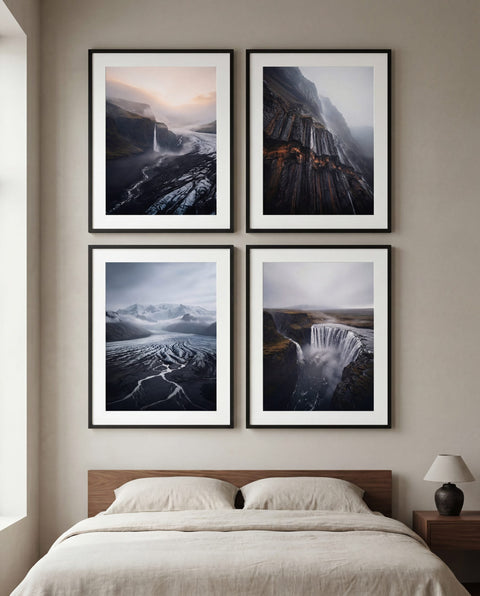
The grid. Identical formats, identical frames, exact rows and columns. Calm, formal, architectural — ideal for a series of works that belong together. The grid forgives nothing: spacing and alignment must be exact.
The edge line. Different formats sharing one straight line — usually the bottom edge. The modern middle ground: more relaxed than a grid, more ordered than a salon wall. Works beautifully above sideboards and consoles.
The salon wall (Petersburg hanging). Many works, mixed sizes, grown around an invisible center axis. The most personal layout of the three — it shows a collection, not a decoration. It has its own rules and its own chapter: read the full salon-style guide for the deep dive.

Gallery wall ideas by room
Living room: the boldest spot. Above a sofa, an edge-line layout or a salon wall both work — keep the group at about two thirds of the sofa's width. Browse wall art for the living room. Bedroom: calm wins. A tight 2x2 grid or a quiet edge line above the headboard, in muted tones — see bedroom wall art. Hallway and office: the natural home of the salon wall — narrow spaces love walls that grow over time. Stairs: follow the diagonal with the center line of each work.

Frames: what holds a mixed wall together
The fastest way to make mixed motifs read as one collection: one frame language. Matte black solid wood frames with white passe-partouts give even wild combinations a calm rhythm — and let the art, not the hardware, do the talking. Two or three frame styles maximum; beyond that, the wall falls apart.
The art: one color world
Layout is only half the answer. What truly holds a gallery wall together is the color world. Choose works that share one mood — moody, color-rich nature in deep teals and warm ambers, say — and any layout works. Mix palettes freely, and even a perfect grid looks accidental.
Spacing and height
Two numbers cover it: 2–3 inches (5–8 cm) between frames — identical everywhere — and the center of the whole arrangement at 57–60 inches (145–150 cm), eye level. Above furniture, the furniture takes over: bottom edge 8–10 inches above the backrest.
How to build your gallery wall in five steps
1. Choose the layout (grid, edge line or salon). 2. Lay everything out on the floor, taped to the wall's dimensions, and photograph the final arrangement. 3. Cut full-size paper templates and tape them up. 4. Hang the anchor piece first, then work from the inside out — level after every frame. 5. Leave room to grow; the best walls are never quite finished.
FAQ
How many pictures make a gallery wall?
From three (edge line) or four (grid); the salon effect starts at five.
Do all frames have to match?
They don't have to — but one frame language makes every layout stronger. Two or three styles maximum.
What sizes should I mix?
One large anchor, two or three mid formats, small accents — and on grids: all identical.
How much space between frames?
2–3 inches, kept constant. The constant gap is what turns frames into a composition.
Where do I start?
With the anchor piece — the largest work, placed near the center. Everything else grows around it.
Building yours? Explore all fine art prints — five sizes, one color world, framed and ready to hang.
Comments (0)
There are no comments for this article. Be the first one to leave a message!